
For patients across Cardiff, South Wales and the wider UK exploring their options, here are seven important things to consider before deciding what is right for you.
1. Your surgeon’s qualifications and experience are worth checking
Your cataract surgeon should be listed on the GMC specialist register for ophthalmology. Any surgeon that started using refractive lens implants from 1st August 2018 onwards must hold the CertLRS. This is not the case for more senior surgeons with established experience in this area of practice prior to 1st August 2018, such as Prof Muhtaseb.
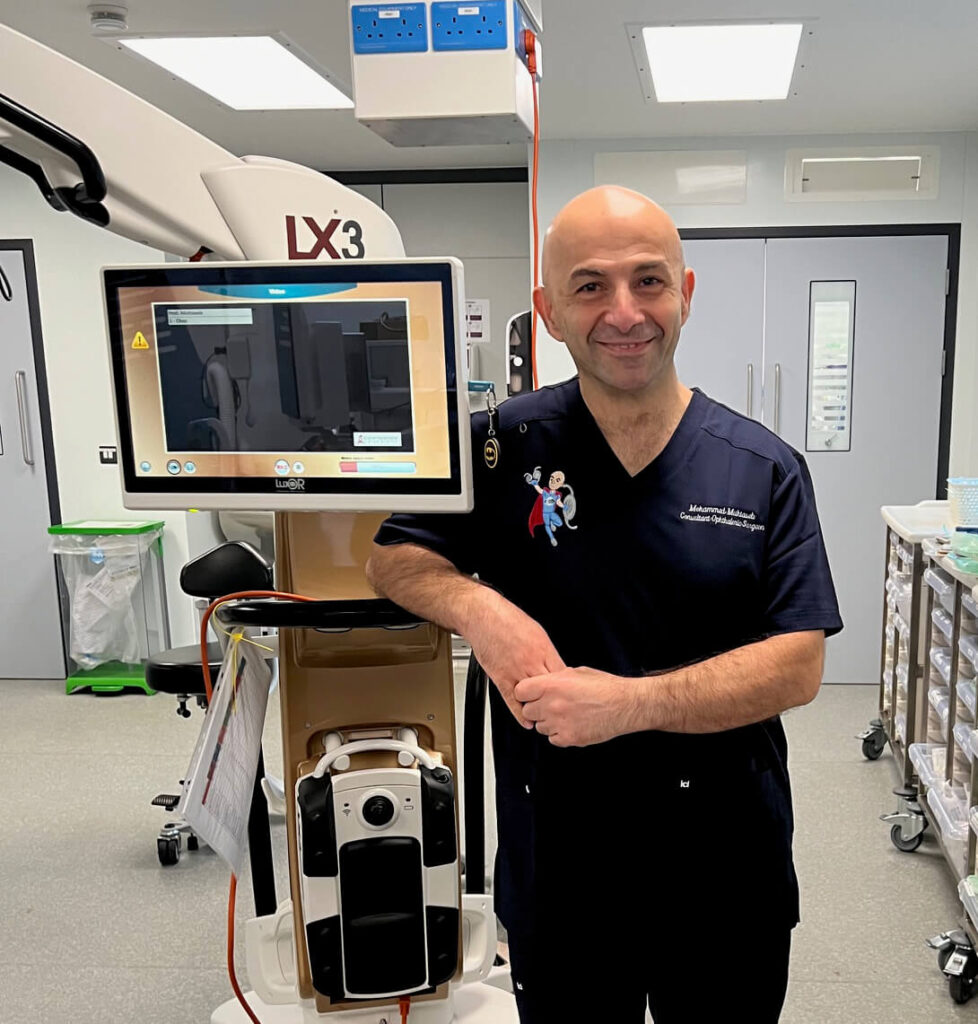
It is also worth asking about their specific experience – some surgeons perform standard cataract surgery only, while others have expertise in complex cases, corneal conditions, astigmatism correction and premium lens options. Prof Mohammed Muhtaseb is a Consultant Cornea, Cataract and Refractive Surgeon, fellowship-trained and an NHS consultant from 2006 – 2025.
“I have been a patient of Prof Muhtaseb for over 10 years and can’t recommend him highly enough. Without his expertise I would not have been able to continue working or driving independently.”
— Verified Google review, May 2026
2. Lens choice should fit your life, not just your prescription
Cataract surgery replaces your cloudy natural lens with an artificial lens. The best lens option for you depends on your desired visual result after surgery, if you are happy to need glasses after surgery, your eye health, work, hobbies, night driving needs and reading habits. Options include standard monofocal lenses, toric lenses for astigmatism, multifocal lenses and extended depth of focus lenses. A good consultation helps you understand the advantages and trade-offs of each – it should never feel like a sales process.
3. The quality of your vision after surgery should be discussed honestly
Cataract surgery is about achieving the best possible vision for your individual case, not just removing the cataract. Ask your surgeon to explain clearly what surgery can and cannot achieve. If you have other conditions such as “lazy eye”, glaucoma, macular degeneration or corneal disease, these may affect your final result. Honest counselling from the outset, further tests as needed, and proper calculations using appropriate mathematical formulae lead to better outcomes and realistic expectations.
There are many ways to measure the eyes and there are even more formulae that can be employed to use these measurements and calculate the lens implant power to provide optimal vision after surgery. This is not generally known by the public but such nuances can have a great effect on the final visual result.
For example, eyes that had prior laser refractive surgery or have underlying conditions will have poorer post-operative unaided vision when standard methods are used, and do best when very specific mathematical methods are used to calculate the lens implant.
Am I suitable for cataract surgery?
Contact us to discuss your options
4. Safety data matters – and your surgeon should be able to discuss it
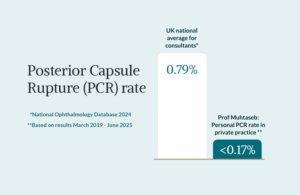
One of the most important questions to ask is how your surgeon monitors safety outcomes. In cataract surgery, a key measure is the posterior capsule rupture (PCR) rate – a nationally recognised marker of surgical risk. A good surgeon should be able to discuss their own rate and how it compares to national benchmarks. For Prof Muhtaseb, safety is central to every decision: careful assessment, clear planning, and a team focused on minimising risk at every stage. Prof Muhtaseb collects all his surgical data and constantly analyses the results to ensure he remains well ahead of national benchmarks.
5. Feeling nervous is completely normal – the right team will take that seriously
Many patients feel anxious about cataract surgery, even knowing it is commonly performed. You should feel able to ask questions about comfort, sedation and what to expect on the day. One important question is whether an anaesthetist is present or available – this matters particularly for patients who are very anxious, have medical conditions, or may benefit from additional monitoring. At iLase, patients should feel informed and properly cared for, never rushed through a process.
“The pre-op consultation was very reassuring and extremely comprehensive. The operation itself was a success — Mum is delighted with the results.”
— Verified Google review, May 2026
6. Ask for a clear breakdown of costs before making any decision
Cataract surgery costs can vary significantly depending on the surgeon, lens type, anaesthetic support, hospital fees and aftercare. Ask what is included: consultation, surgery, lens, follow-up care and any likely extras. Transparent pricing lets you compare properly. A lower headline price may not include the same level of experience, lens choice, or aftercare. You should never feel pressured to book surgery before you fully understand the financial details.
7. You should never feel pushed into surgery
Choosing cataract surgery is a personal decision. Some people are ready to move quickly; others need more time to think, speak to family or compare options. At iLase, we will not pressure you to book, pay a deposit, or choose a lens that does not feel right. Our role is to give you clear information and help you decide at your own pace. If surgery is not right for you yet – or at all – we will tell you that too. Any patient is welcome to return to clinic to ask further questions and discuss any concerns.
“I initially contacted a well known High Street Opticians who offered lens replacement surgery. […] I felt pressurised into booking a date for the procedure together with receiving several phone calls & emails after just one consultation. I felt like a number not an individual. At that stage I took a backwards step & decided to investigate fully who offered a professional service that I could safefully put my trust in…….The name that came up overwhelming was ILASE with outstanding reviews”
— Verified Google review, April 2026
The best cataract surgery decision is one made with good information, realistic expectations, and confidence in the team looking after you. At iLase in Cardiff, our aim is to help patients across South Wales understand their options clearly – so you can choose the right path for your eyes, your lifestyle and your future vision.